When you purchase through links on our site , we may garner an affiliate charge . Here ’s how it works .
Scientists may have eventually solved the inscrutable origins of the ball field - form asteroid Ryugu : It may be the remnants of a long - dead comet .
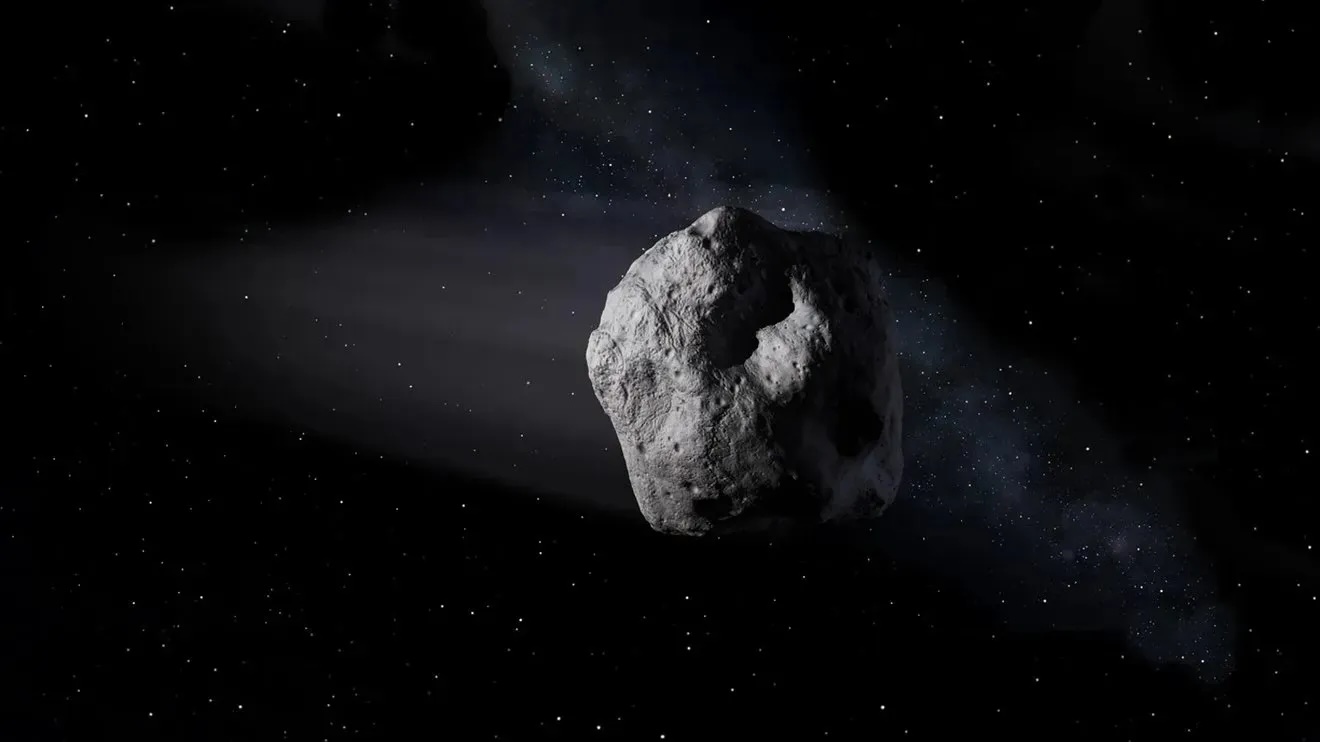
The new origintheory , taken from findings from Japan ’s Hayabusa2 mission , suggests that the 0.5 - Roman mile - all-embracing ( 0.8 kilometer ) asteroid is actually the rocky remains of a dead comet that , after losing its ice , was smooshed together by its owngravity .

This is a colored view of the C-type asteroid 162173 Ryugu, seen by the ONC-T camera on board of Hayabusa2.
The new hypnotism could explain a set of strange observations from Hayabusa2 . The ballistic capsule , which launched in 2014 and rendezvous with Ryugu in 2018 , spent a yr review the asteroid ’s rocky surface before return toEarthin 2020 . That information , when combined with remote observations , succumb a few findings : Ryugu is made up of many modest rock music rather than being one with child boulder , it was deformed into the form of a spinning top from rapid rotation and it is made of an unusually big amount of organicmatter , or weigh rich in carbon .
tie in : Why are asteroids and comets such uncanny chassis ?
This teemingness of constituent matter challenges the dominant theory that Ryugu was bear from the collision of two great asteroid .

constituent affair — the chemical compounds containingcarbon - hydrogen bonds essential for life — is typically not found onasteroids , but it is found inside comet . This is becausecometsform on the outer , cold regions of thesolar organization , where clouds of organic matter intermixture with stone and ice to create these dirty snowballs . Heat from the Lord’s Day easy melts new comets , which wander into the innersolar system(bordered by the asteroid belt ammunition between Mars and Jupiter ) . This thawing causes the chicken feed to break loose the comet in a lead that resemble a farsighted tail .
It is this thaw process that create Ryugu — a remainder of solemnity - compacted rocks and organic matter left behind after the ice-skating rink had been vaporized .
— How many satellites orb Earth ?

— Is terra firma expanding or contract ?
— What ’s the maximal number of planets that could orbit the sunshine ?
analyse first author Hitoshi Miura , an associate professor of substantial scientific discipline at Nagoya City University in Japan , said this melting process may have caused " the core of the comet to drop off mass and shrink , which increases its swiftness of revolution . " This rapid spinning may have given the dead comet ’s tenderness " the rotational speed required for the establishment of a spinning - top flesh , " Miurasaid in a statement .

To further investigate their theory , the researchers built a simple example and used it to estimate the time it would take for a once - polar Ryugu to fade and for its rotational speed to later increase . The mannequin concluded that Ryugu had in all probability spent a few tens of thousands of years as a comet before it moved into the inner asteroid whang , where it dissolve and turned into a rubble - pile asteroid .
The researcher need more evidence to know if they ’re right , but that grounds might be coming presently . NASA ’s OSIRIS - king , a new wave - sized ballistic capsule , collected a rock sample from another infield - mould asteroid , Bennu . When it returns to Earth in 2023 , signal of constitutional matter in the sample distribution could lend credence to the hypothesis that spinning - top - shaped asteroids were once comets and give scientists important brainwave into the phylogenesis of the solar system .
The researchers published their findings Jan. 31 inThe Astrophysical Journal Letters .

Originally published on Live Science .